Hydrogels, coatings, and other kelp based materials.
-
There's an interesting cluster of startups emerging in the New England region.
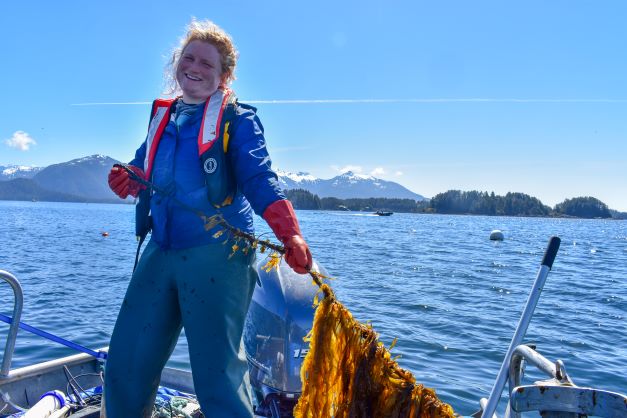
Recently, a cross-disciplinary team of chemists, material scientists, kelp farmers, and designers led by a PI at Pratt Institute, developed a kelp-based hydrogel for agricultural applications. According to the project website, AquaSteady stores 500x its weight in water, creating a natural water reserve in the soil that slowly releases as the gel dries, improving soil microbial activity and plant drought tolerance in the process. These results have been confirmed in lab and greenhouse experiments led by partner-researchers at New Mexico State University , and more trials are under way.FWIW: Kelp and other seaweeds are made up of long, repeating chains of molecules called polymers--the flexible backbone that lets a kelp blade bend without breaking and stay whole in a storm. Companies have long been exploiting these polymers (such as alginate) and adding them to products as gels, thickeners, and the like where they do their jobs with the same unfussy reliability. Hydrogels are networks of polymers that can hold large amounts of water while maintaining a flexible structure.
In addition to giving us the Wizard of Seaweed, @charles_yarish, the University of Connecticut (through it's Center for Entrepreneurship and Innovation) has incubated the development of a couple of new and novel products with kelp grown in Connecticut waters : including a seaweed-based coating to extend the shelf life of fresh produce (Atlantic Sea Solutions, DBA Atlas) and a compostable coating for food-packaging (SeaSol, co-founded by local kelp farmer Jon McGee).
It's still early-days for these innovations, but it’s encouraging to see startups using kelp to address problems that are faced by agriculture and other industries.