
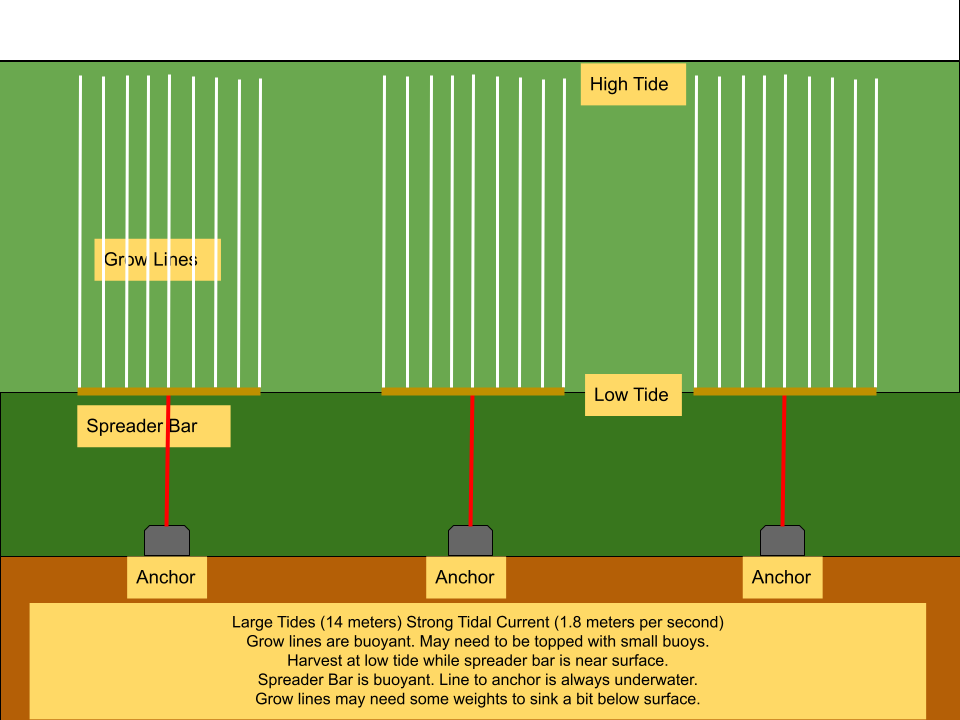
Proposed structure design for high current, high tides.
-
The area in which I'm interested in setting up a polyculture kelp farm is in Shepody Bay, noted for its very high tides (14 meters/46 feet) and strong current (3.5 knots/1.8 meters per second).
It would be difficult to manage the designs described in the course, as the size of the anchors would be huge and it's possible that the current would be too strong for a somewhat fixed system.
So I came up with this design, which would have only one end of the array anchored with the rest of the array floating freely with the changing tidal current.
Any maintenance or harvest would occur during low tide, where the spreader bar and the majority of the grow lines would be accessible.
The spacing would need to be enough so that none of the anchor lines or spreader bars would be able to tangle with each other.
Overcoming the tidal forces would enable the site to take advantage of the high nutrients that are being delivered by the Petitcodiac River, the Memramcook River, and the multitude of creeks and brooks that flow into this area. While the tide is rising, nutrients are also flowing in from what would be considered "downstream" area of the Bay of Fundy.

@david_belliveau - I'd love for @clifford_goudey and @david_bailey to weigh in. I know they are both in the field right now, but I think this is the type of design challenge they might both be interested in--for both anchoring and longline design considerations.
In the meantime, please let me know if I am interpreting your design correctly: will the longlines be positioned vertically in the water column, rising from anchor rode/spreader to surface?
And possibly of interest: though Ocean Rainforest, in the Faroe Islands, does not use single-point moorings, they have used vertical longlines.
@kendall_barbery - Yes. The longlines will tend toward vertical at high tide. During low tide, they'll be horizontal, dragged to the south by the outgoing tidal current.
@kendall_barbery - Yes. The longlines will tend toward vertical at high tide. During low tide, they'll be horizontal, dragged to the south by the outgoing tidal current.
David, it's a fascinating and adventurous idea. I see several concerns. The first is that having bi-directional pull on that single anchor means you can’t exploit the efficiency of drag-embedment anchors. So that leaves you with the dead-weight options or finagling a pair of opposed, closely connected drag-embedment anchors.
A second concern is based on the likely reality that those currents aren’t simply bi-directional with high and low slack water, but more typically having a sideways component that would require greater spacing between the rigs than your sketch suggests.
Finally, given the underwater weight of sugar kelp, those lines would need to have flotation to keep things from sinking to the bottom and up where there’s sunlight. Maybe a buoyant spreader bar across the top ends of those lines is called for. Anyway, let us know if you have any luck.
Cliff
@clifford_goudey -
Thanks for the info. My main concern was whether or not the kelp could hold on in a 3.5 knot current. Further research suggests it does.
I was thinking either more buoyant spreader bars too. or buoys on the lines. I just have to research and think about it a bit more.
The anchors will be a problem. It'll be a lot of concrete, or If I can figure out a way, we have access to an abandoned sandstone quarry that used to make grindstone wheels from the mid 1800 to the mid 1900s. All the big broken grindstones are still there and could be used for anchors. It's just a matter of hauling them out. Either that or a bunch of baskets, similar to the rip-rap baskets you see near bridges and seawalls. A neighbour of mine owns a galvanising plant nearby that would help me out with that part if I need it.
I don't have any pictures of the grindstones, but here are some old photographs from the same quarry with some of the smaller stones that made the grade.
My farm layout has a 40 meter spacing between anchors. This should be large enough to cut down on tangling. Kelp will be Step One in utilizing the site. I'm a Permaculture Designer, so I have to add a whole lot of polyculture, interactive functions, and productive "edges" to try and achieve higher overall productivity beyond growing kelp.
I'll be applying for 225 anchor points, which should take up about 50 hectares, and provide 28,350 meters of grow line. Then I'll fill the gaps with other components over time to turn the area into a jungle of productive biodiversity. This will keep me busy for a while.
@david_belliveau -Hi David, I'm in the process of building a farm in some pretty high current waters (3.5 knots). I'm using a marine engineering firm based in Victoria, BC to help design it including the appropriate anchorage. that I've been quite happy with them however I have to say that as of today it's still all on paper and not in the water yet. If you're interested in their contact info shoot me an email and I can connect you with them (mikeonvashon@yahoo.com)
@mike_spranger -
Thanks Mike. I'm not so much worried about the anchors. I'll simply oversize that part of the system. The 5 line array in the design tool suggested 8 tonne concrete anchors. I'm thinking that the single anchor with lines that are allowed to flow with the current like a horsetail in the wind should be able to cut that estimate down a bit.
I was just worried that the current would rip the kelp off the lines. Although I'm not done researching this part yet, from what I've seen so far, the kelp should hold as long as the lines don't rub against anything else or each other.
@clifford_goudey -
Thanks for the info. My main concern was whether or not the kelp could hold on in a 3.5 knot current. Further research suggests it does.
I was thinking either more buoyant spreader bars too. or buoys on the lines. I just have to research and think about it a bit more.
The anchors will be a problem. It'll be a lot of concrete, or If I can figure out a way, we have access to an abandoned sandstone quarry that used to make grindstone wheels from the mid 1800 to the mid 1900s. All the big broken grindstones are still there and could be used for anchors. It's just a matter of hauling them out. Either that or a bunch of baskets, similar to the rip-rap baskets you see near bridges and seawalls. A neighbour of mine owns a galvanising plant nearby that would help me out with that part if I need it.
I don't have any pictures of the grindstones, but here are some old photographs from the same quarry with some of the smaller stones that made the grade.
My farm layout has a 40 meter spacing between anchors. This should be large enough to cut down on tangling. Kelp will be Step One in utilizing the site. I'm a Permaculture Designer, so I have to add a whole lot of polyculture, interactive functions, and productive "edges" to try and achieve higher overall productivity beyond growing kelp.
I'll be applying for 225 anchor points, which should take up about 50 hectares, and provide 28,350 meters of grow line. Then I'll fill the gaps with other components over time to turn the area into a jungle of productive biodiversity. This will keep me busy for a while.
@mike_spranger -
Thanks Mike. I'm not so much worried about the anchors. I'll simply oversize that part of the system. The 5 line array in the design tool suggested 8 tonne concrete anchors. I'm thinking that the single anchor with lines that are allowed to flow with the current like a horsetail in the wind should be able to cut that estimate down a bit.
I was just worried that the current would rip the kelp off the lines. Although I'm not done researching this part yet, from what I've seen so far, the kelp should hold as long as the lines don't rub against anything else or each other.