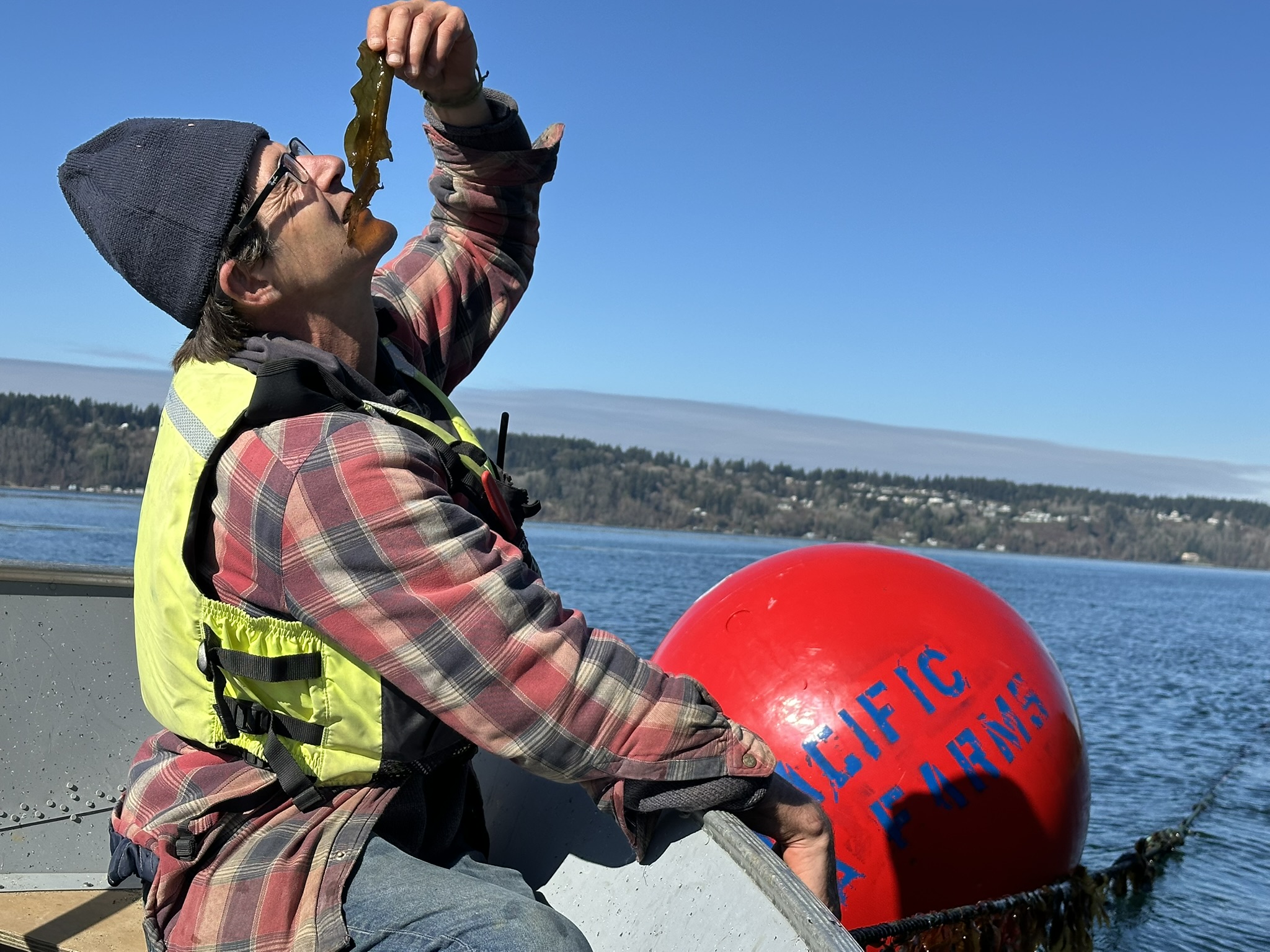
Farm Site Selection tips - video
-
The Greenwave HUB is by far the definitive place for how-to videos on the seaweed farming topic!
In the spirit of "more is better" though, I'm starting a video series that touches on various topics that I've encountered during my farm site setup process.
Here's the first video on choosing a site.. it's certainly not intended to include every consideration but I include 4 key things to think about plus a bonus item..
START A DISCUSSION

@mike_spranger -
What would be the maximum current? I'm looking at Shepody Bay in the Bay of Fundy. But the max currents are between 3 and 4 knots.
@david_belliveau -I can't say what a "max" current would be to grow seaweed but my site has some pretty swift and tricky waters.. Here's a cool graph based on data I got from an ADCP I deployed..
It shows that the max current was about 1.75 meters/second or 3.3 knots.. According to the marine engineer that I'm using to help design my farm, "The Norwegian standard for finfish systems (there aren't standards for seaweed farm systems) states that a factor of 1.85 can be applied to the maximum measured current". I'm going to be more conservative and us a factor of 2.0. This results in a maximum longitudinal current of 3.46m/s (~6.72 knots) which is what I have based my anchor holding power on.
@david_belliveau - 1-2 knots of current is generally recommended for sugar kelp cultivation, but some farmers are working in more exposed waters and/or around swifter currents. @suzie_flores's farm in Fisher's Island Sound, on the Connecticut-Rhode Island border, experiences currents in excess of 2 knots at certain tide stages. GreenWave has a pilot farm in Humboldt Bay, CA where we cultivate bull kelp--and the site experiences currents over 3 knots of current, usually on the ebb.
Some species may be more tolerant of swifter currents (what naturally grows in/near your area, for example). One thing to bear in mind is that drag (on your kelp, longlines, and gear) increases as current increases--and will impact the recommended anchor size for your farm site (meaning, your anchor holding power needs increase as current increases; you can model this in the Farm Design tool in this Hub). If your longlines are oriented perpendicular to current, there will be more drag (imagine all of the kelp fanning out as the water moves through the farm). For reference, our bull kelp longlines in Humboldt Bay are oriented parallel to current.
Find some more tips and guidance in the Site Evaluation Course (navigate to Courses on the left hand menu)--the Environmental Suitability course, in particular.
@david_belliveau -I can't say what a "max" current would be to grow seaweed but my site has some pretty swift and tricky waters.. Here's a cool graph based on data I got from an ADCP I deployed..
It shows that the max current was about 1.75 meters/second or 3.3 knots.. According to the marine engineer that I'm using to help design my farm, "The Norwegian standard for finfish systems (there aren't standards for seaweed farm systems) states that a factor of 1.85 can be applied to the maximum measured current". I'm going to be more conservative and us a factor of 2.0. This results in a maximum longitudinal current of 3.46m/s (~6.72 knots) which is what I have based my anchor holding power on.
@mike_spranger- Thanks for sharing!
@david_belliveau - 1-2 knots of current is generally recommended for sugar kelp cultivation, but some farmers are working in more exposed waters and/or around swifter currents. @suzie_flores's farm in Fisher's Island Sound, on the Connecticut-Rhode Island border, experiences currents in excess of 2 knots at certain tide stages. GreenWave has a pilot farm in Humboldt Bay, CA where we cultivate bull kelp--and the site experiences currents over 3 knots of current, usually on the ebb.
Some species may be more tolerant of swifter currents (what naturally grows in/near your area, for example). One thing to bear in mind is that drag (on your kelp, longlines, and gear) increases as current increases--and will impact the recommended anchor size for your farm site (meaning, your anchor holding power needs increase as current increases; you can model this in the Farm Design tool in this Hub). If your longlines are oriented perpendicular to current, there will be more drag (imagine all of the kelp fanning out as the water moves through the farm). For reference, our bull kelp longlines in Humboldt Bay are oriented parallel to current.
Find some more tips and guidance in the Site Evaluation Course (navigate to Courses on the left hand menu)--the Environmental Suitability course, in particular.
Thanks for sharing, @mike_spranger! Looking forward to upcoming episodes.
@mike_spranger -thanks so much for sharing this is what I've been really looking for