Remember to check your permits for the latest date your gear is allowed to be in the water. If there are seasonal restrictions, depending on how big your farm is, you’ll need to estimate how many tons of kelp you will need to harvest each week before the permit expires.
Lesson 2
Timing Your Harvest
Back to: Harvest
Consider Multiple Harvests
There are a range of factors that will impact when harvest begins. The longer your kelp stays in the water, the greater your yields. But as waters start to warm, your kelp can quickly degrade in quality due to fouling organisms. This constant tension between quantity and quality is something you’ll continue to grapple with every harvest season.
Many farmers who sell to large-scale wholesale buyers choose to harvest in one go. Depending on the size of your farm, this could happen in one day or over the course of several days. Harvesting in one episode is the most efficient and cost-effective way to get your crop out of the water.
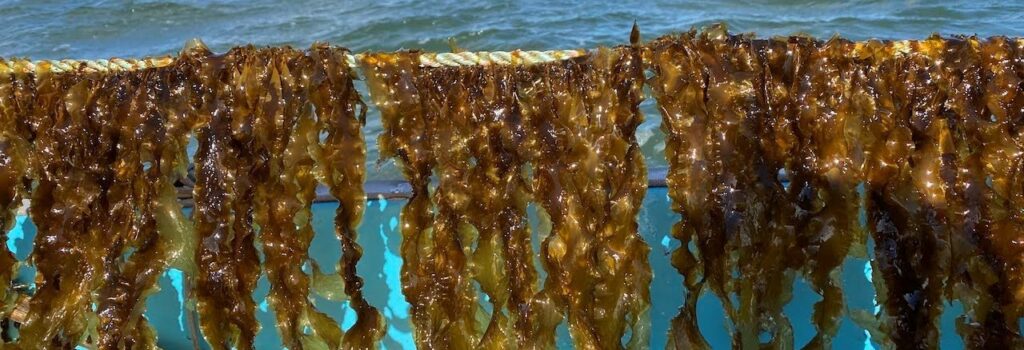
Farmers who are direct-marketing fresh kelp to individual consumers or smaller-scale wholesale customers may choose to space out their harvest over multiple weeks and start earlier in the season.
The highest quality, most delicate “baby kelp” is often seen in the early spring around March or April. These juvenile kelp blades are typically mild in flavor and delicate in texture. Some farmers have made a point of marketing baby kelp to chefs and foodies at a high price point, sometimes upwards of $22/lb. The price is good, but it can be a lot of work to coordinate multiple low-volume deliveries. You’ll need to determine if this type of early harvest makes sense on your farm. The ancillary benefit of harvesting an early crop of baby kelp is that thinning out the lines can result in the remaining blades growing wider and faster because they have more space and less competition for nutrients.
Industry Tip