Dewatering
The process of removing any excess water on the outside of the kelp. Dewatering is commonly done using a spinner or a mesh table that allows the kelp to drip dry.
Back to: Harvest
The precise details on how you will hand off harvested kelp will need to be negotiated on a case-by-case basis with your buyer. That said, there are a few areas we strongly recommend discussing and agreeing upon in writing well in advance of harvest day.
Regardless of where you are meeting your buyer, you will need a plan for getting your harvested kelp off your boat and onto a vehicle. Make sure you understand what equipment and support your marina can provide — in the form of cranes, forklifts, or able-bodied people — as well as how much those services cost, and who will be paying for them.

In most cases, your buyer will be paying by the wet pound for your kelp. So you’ll want to be clear on when and how that weight is being taken. Ideally, this process can take place dockside where a representative of each party can view and confirm the weight. Hanging scales work well if a crane is already being used to move kelp from a boat to a vehicle; alternatively, some trucks may have liftgate scales.
The process of removing any excess water on the outside of the kelp. Dewatering is commonly done using a spinner or a mesh table that allows the kelp to drip dry.
Because freshly-harvested kelp often has a significant amount of surface water, your buyer may require a dewatering step prior to weighing so that they are not paying for water. Dewatering simply means removing any excess water on the outside of the kelp and is commonly done via a spinner or a mesh table or belt that allows the kelp to drip dry. If it is impractical to dewater the entire load of kelp, a buyer may dewater a smaller sample to determine the ratio of the dewatered weight to the freshly-harvested weight. This ratio can then be applied as an adjustment to the total harvest weight
For example, if a 20 lb sample of freshly harvested wet kelp is put into an industrial salad spinner and the resulting, dewatered weight is 17 lbs, the dewatering ratio is 85%. If a total of 10,000 lbs of wet kelp was sold to a buyer that uses this method, they would apply the 85% ratio and payout on 10,000 x 0.85 = 8,500 lbs of dewatered kelp.
In the best-case scenario, deterioration or discoloration will be present on the tips of the kelp only, there will be no visible organisms present, and no signs of grazing. However, especially later in the season, you may start to see bio-fouling organisms, holes, or twisted, wrinkled, roughened, or blistered blades. Some bio-fouling organisms are washable (e.g. snails, shrimp, or urchins), while others are not (e.g. bryozoans, hydroids). You will need to communicate early and often with your buyer to understand what level of bio-fouling or deterioration is acceptable for their processing and end uses, who is responsible for sorting kelp, and whether the pay structure will vary depending on kelp quality.
Sorting is the process by which pristine food-grade kelp is separated from damaged, dirty, or bio-fouled kelp.
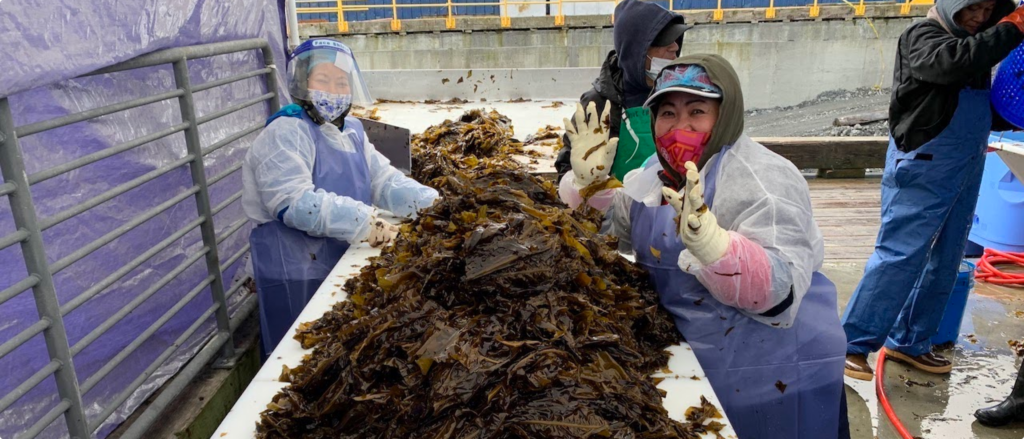
You will also need to agree on who is responsible for transporting your harvested kelp, which should reach the processing facility within 48 hours of being removed from the water, according to the Seaweed Handling and Processing Guidelines for Alaska. Transportation can be logistically complicated and expensive since sugar kelp must be maintained at or below 40 degrees F during transportation, which for all but the smallest volumes will require the use of a refrigerated vehicle. Refrigerated vehicles can be rented for $150-200 per day or $700-900 per week, plus an additional per-mile charge for usage.